
Do Hashtags Still Work on Instagram in 2026? Instagram Can't Decide Either


If you open Instagram's post composer right now, it will still tell you to "add relevant hashtags" so more people who care about your topic can find your content. Meanwhile, Instagram's own CEO has spent the better part of two years telling anyone who'll listen that hashtags don't do that.
That's the real story behind "do hashtags still work on Instagram." It's not a simple yes or no. It's a platform that changed how hashtags function, said so publicly, and then kept a UI that implies the opposite. Both things are true at once, and untangling them tells you a lot more about what actually drives reach in 2026 than another list of "best hashtag strategies" would.
What Mosseri actually said
Instagram's head, Adam Mosseri, has repeated this line in Q&A sessions for a couple of years now, and he said it again as recently as this year: hashtags aren't a way to get more reach. They're a way to tell people what your post is about and to connect it to related posts. Useful for search, not for distribution.
That's a meaningfully different claim than "hashtags used to work and stopped working." Mosseri's version is retroactive — his position is that hashtags never drove reach the way an entire industry of hashtag-research tools and "30 hashtags for growth" advice assumed they did. The correlation people saw for a decade wasn't hashtags causing reach. It was good content getting tagged well, and people crediting the tags.
Two platform changes back this up. Instagram removed the ability to follow a hashtag in December 2024, so tags no longer feed a subscriber-style stream the way they did for years. And the number of hashtags allowed per post dropped from 30 to 5. You don't cut a tool's ceiling by 83% if you think it's a growth engine.
So why does Instagram's own composer still push you to add them?
Chris Messina, who invented the hashtag on Twitter back in 2007, has pushed back on the "hashtags are dead" narrative directly, arguing they're still central to how people organize and find content across social platforms. Social media analyst Matt Navarra takes the middle ground: hashtags aren't the discovery engine they used to be, by design, but calling them irrelevant overstates it — they've just become platform-specific tools rather than universal growth hacks.
Instagram's own product team seems caught in the same in-between. The prompt to add hashtags is still there because tags still do something — they just don't do the thing the prompt implies. That gap between "add hashtags to reach more people" and "hashtags don't affect reach" is Instagram simultaneously running old UX copy and a new algorithmic reality that hasn't caught up to each other yet.
What the data actually shows
Numbers help more than quotes here. A recent analysis of 1.6 million Instagram posts looked specifically at how hashtag count relates to reach and engagement, and the pattern is oddly specific: posts with 5 hashtags — the current maximum — perform best on both metrics, narrowly beating posts with 4. Posts with 1 to 3 tags actually underperform posts with zero. And anything that overshoots the 5-tag limit trends back down.
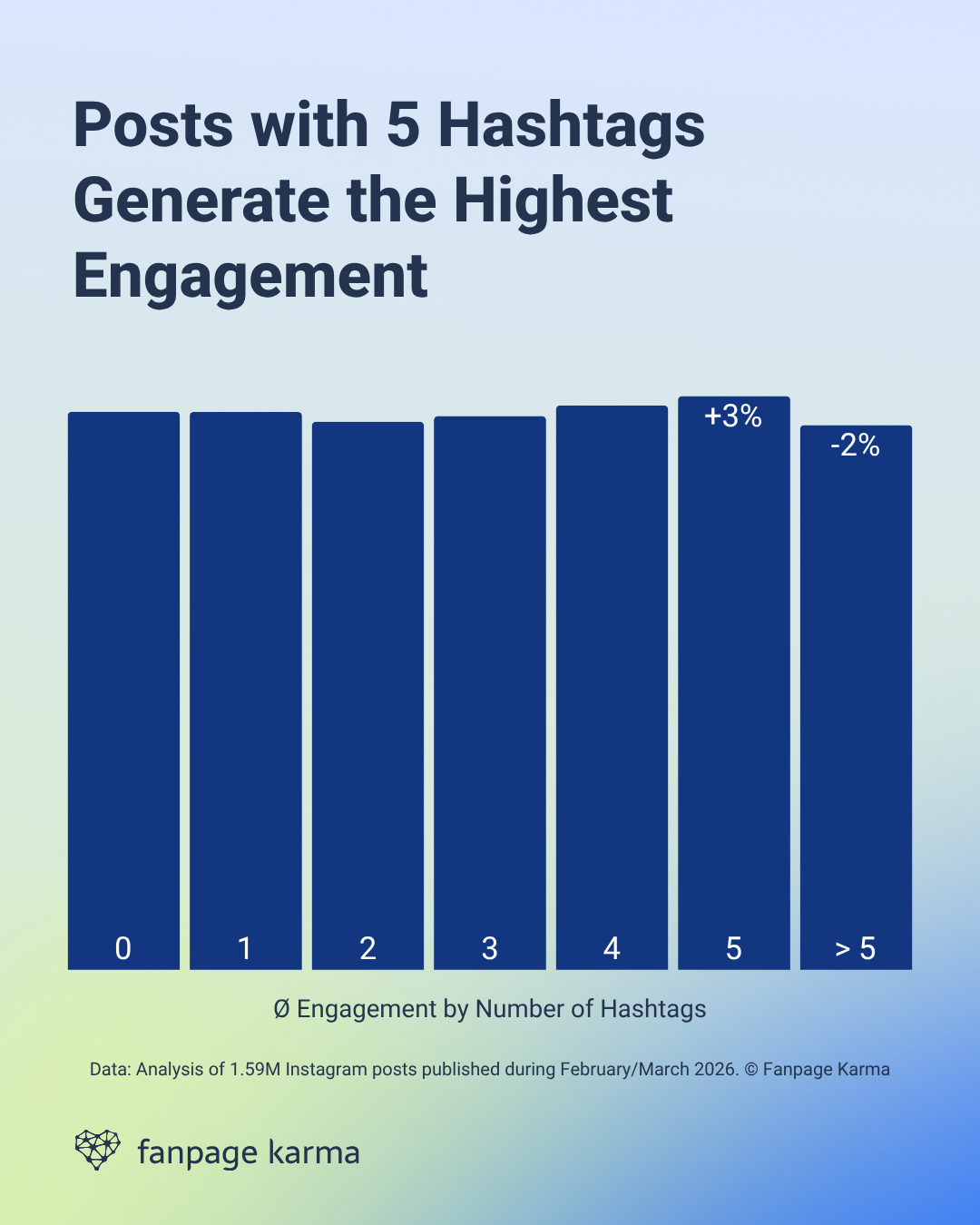
Worth sitting with that for a second, because it doesn't fit either popular narrative. It's not "more hashtags equals more reach" — going over 5 hurts you. It's not "hashtags don't matter" either — 0 hashtags loses to 5. What it looks like instead is a sweet spot tied to the platform's current limit, with a light penalty for combinations that look either lazy (1-3 generic tags) or spammy (well past what's allowed).
One caution worth flagging, since this kind of study invites it: correlation still isn't causation here. Accounts that consistently fill all 5 hashtag slots with relevant, well-researched tags are probably also the accounts doing everything else right — consistent posting, clear niches, strong captions. Some of that "5 hashtags perform best" lift is likely hashtags doing their small, real job as a classification signal, and some of it is just that organized accounts use 5 hashtags and also happen to post better content.
How do hashtags actually work on Instagram now?
Think of it as a demotion from lever to label. Instagram's ranking systems evaluate a post primarily through its content — captions, on-screen text, spoken audio in Reels, visual recognition, and how people interact with it. Roughly half of what shows up in an average feed today is Instagram's own suggestions, pulled from that contextual read of a post, not from people who typed a hashtag into search.
Hashtags now feed into that same contextual read as one input among many. They tell the algorithm what category your post belongs to and connect it to a thread of similar content, which matters for things like:
- A branded or campaign tag that gathers every related post — yours and your community's — in one place
- A niche or community tag (#skincarecommunity, #vanlifeliving) that signals audience fit more precisely than a caption alone might
- Search, where users increasingly type keyword-style queries rather than browse a hashtag feed, closer to how they'd search Google
What they no longer do is put your post in front of people who follow that tag, because following tags doesn't exist anymore, and they don't meaningfully expand your reach on their own, because reach is decided by engagement and relevance signals first.
What actually moves reach instead
If hashtags aren't the lever, something is, and it's the same handful of things across most current reporting on the topic: how long people watch, whether they save or share a post, whether your caption uses the actual words your audience searches for, and whether you post consistently enough for the algorithm to have a read on your account at all. Trending audio still gives Reels a real boost too — arguably more than any hashtag combination will.
That's also where hashtag research earns its keep, just repositioned. Instead of hunting for tags to trigger reach, the useful question becomes which topics and phrases your actual audience is already using — in captions, comments, and hashtags across your niche — so your own tagging and caption language match real search behavior instead of guessing. A social listening tool that tracks hashtag and keyword volume across a niche (Awario is one) is more useful for that kind of audience research than for the old-school "find me a trending tag" hunt, since it shows you what a community is actually saying, not just what's popular in a vacuum.
A workable hashtag strategy for 2026
Given all of the above, here's what's actually worth doing:
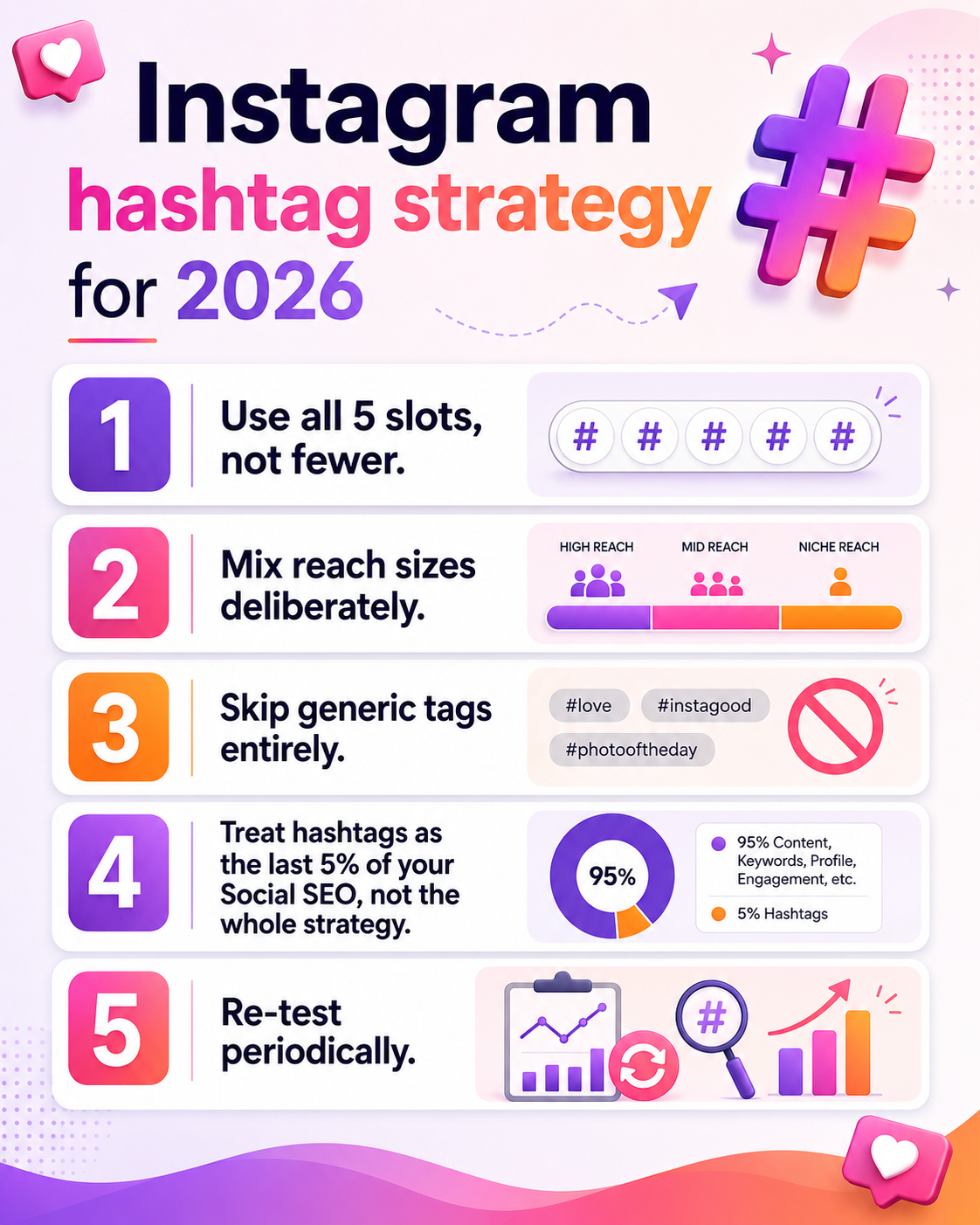
- Use all 5 slots, not fewer. The data lines up with the platform's own limit — 5 relevant tags outperforms both fewer tags and going over.
- Mix reach sizes deliberately. A combination of 2-3 broader tags, 1-2 mid-sized ones, and 1 specific niche tag beats a set that's all broad or all niche. Broad tags without context are too vague to help the algorithm place you; niche tags without any broader signal cap your audience unnecessarily.
- Skip generic tags entirely. #love, #instagood, and their relatives are too saturated to categorize anything meaningfully. Industry and community-specific tags do the actual work.
- Treat hashtags as the last 5% of your Social SEO, not the whole strategy. Get the keywords your audience actually searches into your caption and on-screen text first. Hashtags reinforce that signal; they don't replace it.
- Re-test periodically. Whatever combination is quietly working for your niche today shifts as the algorithm and your audience's habits shift. Treat hashtag sets like any other variable worth revisiting every few months, not a "set it once" decision.
The honest answer
Do hashtags still work on Instagram in 2026? Yes, in the narrow sense that using 5 relevant ones correlates with slightly better reach and engagement than using none, and they genuinely help categorize your content for both the algorithm and actual human search. No, in the sense that matters most to anyone who built a strategy around them: they were never the reach lever the last decade of advice claimed, and Mosseri saying so out loud just made it official. Instagram's composer hasn't updated its language to match. Your strategy should.